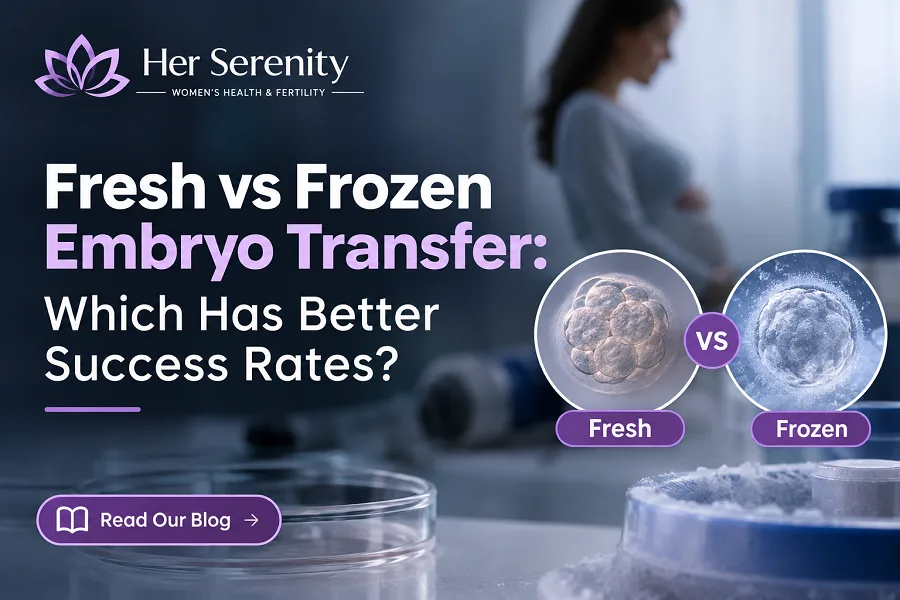
Fresh vs Frozen Embryo Transfer: Which Has Better Success Rates?
Fresh vs frozen embryo transfer: what research says about IVF success rates, OHSS risk, costs, and which transfer may suit your situation.
If you're preparing for IVF, you may wonder whether transferring an embryo immediately or freezing it for later gives you a better chance of pregnancy. It's a common question, especially when both approaches are available.
Research shows that frozen embryo transfers don't consistently achieve higher success rates than fresh transfers. Outcomes depend on your age, embryo quality, ovarian response, and medical history. For some patients, fresh transfer may be equally effective or even preferable.
At Her Serenity, the team helps patients understand these differences, review fertility assessments, and discuss treatment timing. The goal is to find an approach that makes medical sense for your circumstances.
What Is a Fresh Embryo Transfer?
A fresh embryo transfer takes place during the same IVF cycle as egg retrieval. After eggs are collected and fertilized in the laboratory, an embryo is usually transferred into the uterus three to five days later. Suitable additional embryos may be frozen for future use.
The main advantage is timing. You don't need to wait for another treatment cycle before attempting pregnancy. However, ovarian stimulation can temporarily affect hormone levels.
If your ovaries respond strongly or your uterine lining isn't ready, your fertility specialist may recommend postponing the transfer. Her Serenity's IVF and conception care supports individualized treatment planning, including reviewing stimulation responses and discussing embryo transfer timing.
What Is a Frozen Embryo Transfer?
A frozen embryo transfer (FET) uses an embryo that was previously created through IVF and cryopreserved. Before transfer, the embryo is thawed, and the uterine lining is prepared through either a natural or medication-supported cycle.
This approach separates egg retrieval from embryo transfer. It gives the care team more flexibility when planning treatment around hormone levels, uterine conditions, or medical needs.
Frozen transfer also allows embryos to be stored for future pregnancy attempts. Through our embryo freezing services, Her Serenity helps patients understand embryo development, storage decisions, and preparation for future transfers.
Fresh vs Frozen Embryo Transfer: Key Differences
Both methods involve placing an embryo into the uterus. The main differences concern timing, preparation, and clinical considerations.
| Factor | Fresh Embryo Transfer | Frozen Embryo Transfer |
|---|---|---|
| Timing | Usually 3–5 days after egg retrieval | During a later treatment cycle |
| Embryo freezing | Not required for transferred embryo | Required |
| Uterine preparation | Follows ovarian stimulation | Natural or medication-supported cycle |
| Treatment flexibility | More limited | Greater scheduling flexibility |
| OHSS considerations | May be unsuitable for high-risk patients | Freeze-all strategy can reduce OHSS risk |
| Additional expenses | Usually fewer freezing-related costs | Freezing, storage, and thawing costs |
| Main uncertainty | Implantation, pregnancy, and live birth | Embryo survival after thawing, implantation, pregnancy, and live birth |
Neither option guarantees a successful pregnancy. Your clinical circumstances matter more than choosing one method simply because it is newer or more commonly used.
Which Has Better IVF Success Rates?
Research comparing fresh and frozen embryo transfers has produced different results across patient groups.
A randomized trial published on PubMed involving 2,157 ovulatory women undergoing IVF reported live birth rates of 48.7% following frozen transfer and 50.2% following fresh transfer. The difference was not statistically significant.
A separate randomized study published in The BMJ in 2025 examined women with a low prognosis for IVF success. It reported live birth rates of 32% with a freeze-all strategy compared with 40% with fresh transfer.
These findings suggest that freezing every embryo isn't automatically the better approach.
It's also important to distinguish pregnancy rates from live birth rates. A positive pregnancy test doesn't always lead to a live birth, making live birth outcomes particularly useful when comparing treatments.
Her Serenity helps patients discuss fertility history and treatment findings so they can ask their fertility specialist for success estimates relevant to their age, embryo characteristics, and previous IVF results.
What Factors Affect Embryo Transfer Success?
Age at Egg Retrieval
Age affects egg quality and the likelihood of developing embryos capable of resulting in a live birth.
For frozen embryos, age at egg retrieval is particularly important because the embryos retain the reproductive characteristics associated with when the eggs were collected. Freezing embryos doesn't reverse age-related changes already present in the eggs.
Embryo Quality and Development
Embryos differ in their developmental stage and appearance. These characteristics help embryologists assess which embryos may be suitable for transfer or freezing.
Preimplantation genetic testing may provide additional information in selected circumstances, but it isn't necessary or beneficial for every patient and cannot guarantee implantation.
Hormone Levels and Uterine Readiness
Successful implantation depends partly on appropriate coordination between embryo development and the uterine lining.
A frozen transfer may be considered when hormone levels or endometrial conditions make fresh transfer less suitable.
Her Serenity's IVF planning process includes reviewing monitoring results and coordinating discussions about treatment timing.
When Might Frozen Embryo Transfer Be Better?
Frozen transfer may be particularly useful when a patient has a high ovarian response or faces an increased risk of ovarian hyperstimulation syndrome (OHSS).
OHSS is a potentially serious complication of ovarian stimulation. Freezing embryos and delaying transfer can reduce this risk.
The American Society for Reproductive Medicine recommends considering a freeze-only cycle for patients at increased OHSS risk because of high ovarian response or elevated estradiol levels.
Frozen transfer may also be appropriate when embryo genetic testing is planned or when uterine conditions require additional evaluation.
These are reasons to consider delaying transfer, not proof that frozen embryos always produce better pregnancy outcomes.
When Might Fresh Embryo Transfer Be Better?
Fresh transfer can be reasonable when ovarian stimulation has progressed safely, the uterine lining is suitable, and no medical reason exists to delay pregnancy. It may reduce the time between egg retrieval and the first pregnancy attempt.
Some patients with a lower ovarian response may also benefit from avoiding a routine freeze-all strategy. However, this decision depends on embryo development, hormone levels, and the treating specialist's assessment.
A fresh transfer isn't necessarily less advanced than a frozen transfer. Both are established IVF approaches with different advantages.
Fresh vs Frozen Embryo Transfer: Cost Comparison
Costs can also influence the decision, particularly when insurance coverage is limited. With a fresh transfer, expenses typically include ovarian stimulation, monitoring, egg retrieval, fertilization, embryo culture, transfer medications, and the transfer procedure.
A frozen transfer involves those initial IVF expenses plus embryo freezing and potentially storage fees. Later costs may include thawing, uterine preparation, monitoring, and the frozen transfer procedure.
A frozen cycle can therefore introduce additional expenses, although actual costs depend on the treatment plan and whether embryos are already stored. Before deciding, request an itemized estimate covering laboratory fees, medications, cryopreservation, annual storage, future transfers, and insurance coverage.
Her Serenity offers consultations where patients can discuss treatment costs, insurance questions, and the practical steps involved in their IVF plan.
How Her Serenity Helps You Choose the Right Transfer
Choosing between fresh and frozen embryo transfer involves more than comparing percentages. Your fertility history, response to treatment, embryo development, and personal timeline all deserve consideration.
Her Serenity helps patients review their circumstances, understand fertility testing and monitoring results, and coordinate discussions about IVF treatment options. Our team also supports embryo freezing decisions and planning for future transfers.
During your consultation, you can discuss whether fresh transfer is appropriate, when freezing embryos may offer medical advantages, what success rates mean for your situation, and which expenses to expect.
Book a free consultation with Her Serenity to explore your IVF options and plan your next steps with greater confidence.